TopicsDepression and Anxiety
Book coming soon

You are allowed to be sick and faithful at the same time.

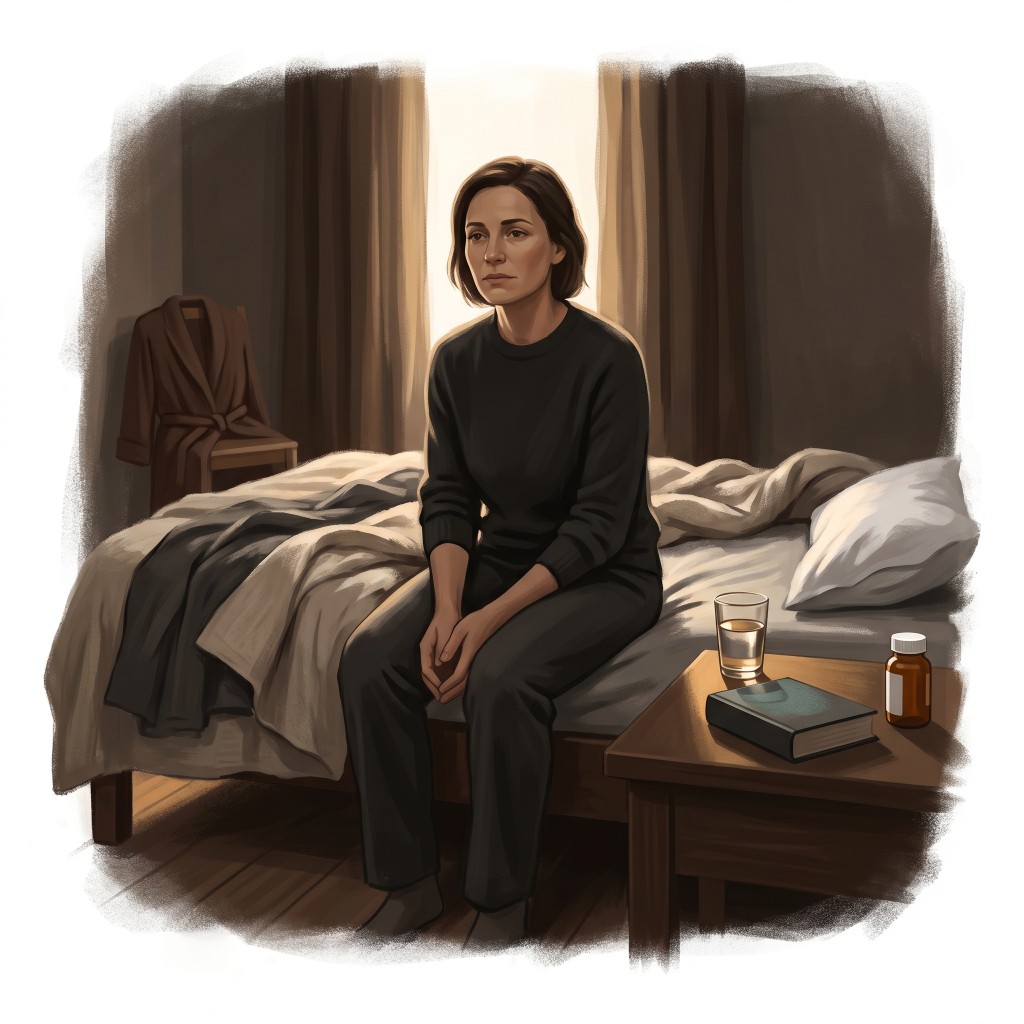
A person sitting on the edge of a bed at first light, a glass of water and scriptures on the nightstand.

Shame's Lie versus God's Thoughts

Shame's Lie

If I had real faith, I wouldn't feel this way. So something must be wrong with my soul.

God's Thoughts

Christ sweat blood in Gethsemane — and took the angel's help. The help is not a failure of faith. It's the answer to it.

Watch these

Thru Cloud and Sunshine, Love at Home

Sister Reyna I. Aburto

Aburto, then-second counselor in the Relief Society General Presidency, speaks publicly and personally about her own depression. She names it from the pulpit in a session of General Conference. She tells members that depression and anxiety are not the result of weakness, and that loving someone through these illnesses looks like presence and patience, not lectures.

Addressing Mental Health

Elder Erich W. Kopischke

Kopischke speaks about a member of his own family's mental illness and what his family learned. He repeats Holland's principle and extends it: challenges indicate a need for tools, not a character defect. He invites members to stop hiding mental health struggles inside their wards.

The contrary

Both of these are in your scriptures. Both are true.

"Wickedness never was happiness."

— Alma 41:10

"Then cometh Jesus with them unto a place called Gethsemane… and began to be sorrowful and very heavy. Then saith he unto them, My soul is exceeding sorrowful, even unto death."

— Matthew 26:36–38

Prophet voices

"Broken minds can be healed just the way broken bones and broken hearts are healed. While God is at work making those repairs, the rest of us can help by being merciful, nonjudgmental, and kind."

— Elder Jeffrey R. HollandLike a Broken Vessel, October 2013 General Conference

"If you suffer from depression, anxiety, or any other emotional or mental challenges, please know you are not alone. Your struggles do not define you, but they can refine you."

— Sister Reyna I. AburtoThru Cloud and Sunshine, Love at Home, October 2019 General Conference

"Mental illness is not a result of sin. It is not a flaw of character. Mental illness is a real illness, and it can affect any of us at any time."

— Elder Erich W. KopischkeAddressing Mental Health (paraphrased pattern — verify wording before citation), Liahona, October 2021

More than one side of the same God

Elijah under the juniper tree — God sent food and sleep, not a sermon.

Elijah had just performed one of the greatest miracles in scripture — fire from heaven on Carmel — and within a day he was running for his life, alone, suicidal: "It is enough; now, O Lord, take away my life; for I am not better than my fathers" (1 Kings 19:4). God did not say "have more faith." He did not say "I just spoke to you with literal fire — get up." He sent an angel to bake bread, brought water, let Elijah sleep, and woke him to eat again. Twice. Then He brought Elijah to a quiet mountain and met him not in the wind, not in the earthquake, not in the fire — but in "a still small voice" (1 Kings 19:5–12). God's response to a prophet's suicidal exhaustion was rest, food, and gentleness. Then mission. In that order. That is the pattern.

1 Kings 19:4–12

Read more from the bookFull scenario, scripture, and the both-are-good frame

Both are good

Faith that endures.

Mosiah 24:14–15

Help that heals.

Luke 5:31

Read the moment

She has done all the things. She prays in the morning and at night. She reads her scriptures most days. She holds her calling. She takes the sacrament. And for six months — maybe longer — she has woken up tired in a way sleep doesn't fix. Her chest feels tight on Sunday before church. She cries at small things and feels nothing at big ones. The voice in her head says: if you had real faith, this wouldn't be happening. You must be doing something wrong. God is withdrawing because you're slipping. She is not slipping. She is sick. The body she lives in has chemistry, and the chemistry is off, and no amount of additional scripture study is going to correct it any more than additional scripture study would correct a thyroid. What she needs is the same thing Elijah needed: food, sleep, water, gentleness, and someone who says yes, this is real, and yes, you are still loved, and yes, the doctor is part of God's plan for you. If she had a kidney infection, she would go to the doctor on day three and not feel guilty about it. The same compassion is owed her brain, her nervous system, her grief. Heaven is not embarrassed by mental illness. The shame is not from God.

"Broken minds can be healed just the way broken bones and broken hearts are healed."

— Elder Jeffrey R. Holland (October 2013)

God's Example

Christ in Gethsemane was not a failure of faith.

The most spiritually perfect being who ever lived walked into a garden and "began to be sore amazed, and to be very heavy" (Mark 14:33). He fell on His face. He asked the Father — three times — for the cup to pass. He sweat blood. He said "my soul is exceeding sorrowful, even unto death." If feeling that depth of suffering meant unworthiness, the Atonement could not have happened. The capacity to feel sorrow that intense was required — not condemned. Christ's anguish was not the absence of God; it was the moment God walked closest. "And there appeared an angel unto him from heaven, strengthening him" (Luke 22:43). Heaven sent help. He took the help. The taking did not invalidate the prayer.

Mark 14:33–36; Luke 22:43–44

Bridle it: right time, right place, right person, right reason.

God doesn't approve of either extreme

This is not an excuse. God wants both — faith that holds and the wisdom to use the help He has placed on the earth. Bridle this.

Using illness to disengage permanently from covenant practice

Using mental illness as a reason to disengage permanently from covenant practice — "I'm too anxious to ever go to church again, so I won't, ever" — short-circuits the very community designed to carry you. Therapy is not a replacement for the sacrament; the sacrament is not a replacement for therapy. The bridle: scale honestly in a season of acute illness, return to the practice as the body is able. The trap is forgetting that the season ends.

"Bear ye one another's burdens, and so fulfil the law of Christ."

— Galatians 6:2

Refusing to acknowledge the illness

Refuse to acknowledge it? You will become more religious in your performance and more empty in your soul, and eventually one will give way. The bishop who white-knuckles his depression because "a bishop should be okay," the mother who has not slept in weeks and refuses help — every one of them is making the wound worse by refusing to name it. Naming it is not weakness. Naming it is the first act of stewardship over a body God gave you.

"And there appeared an angel unto him from heaven, strengthening him."

— Luke 22:43

Take the bread. Take the water. Adjust. Come back.
Hand this to someone.

Two Are True is a small, gift-able book — designed to be opened to any page and read in under a minute. Send a copy. Leave one in a bathroom. Give one to a teenager.

Get the book — coming soon